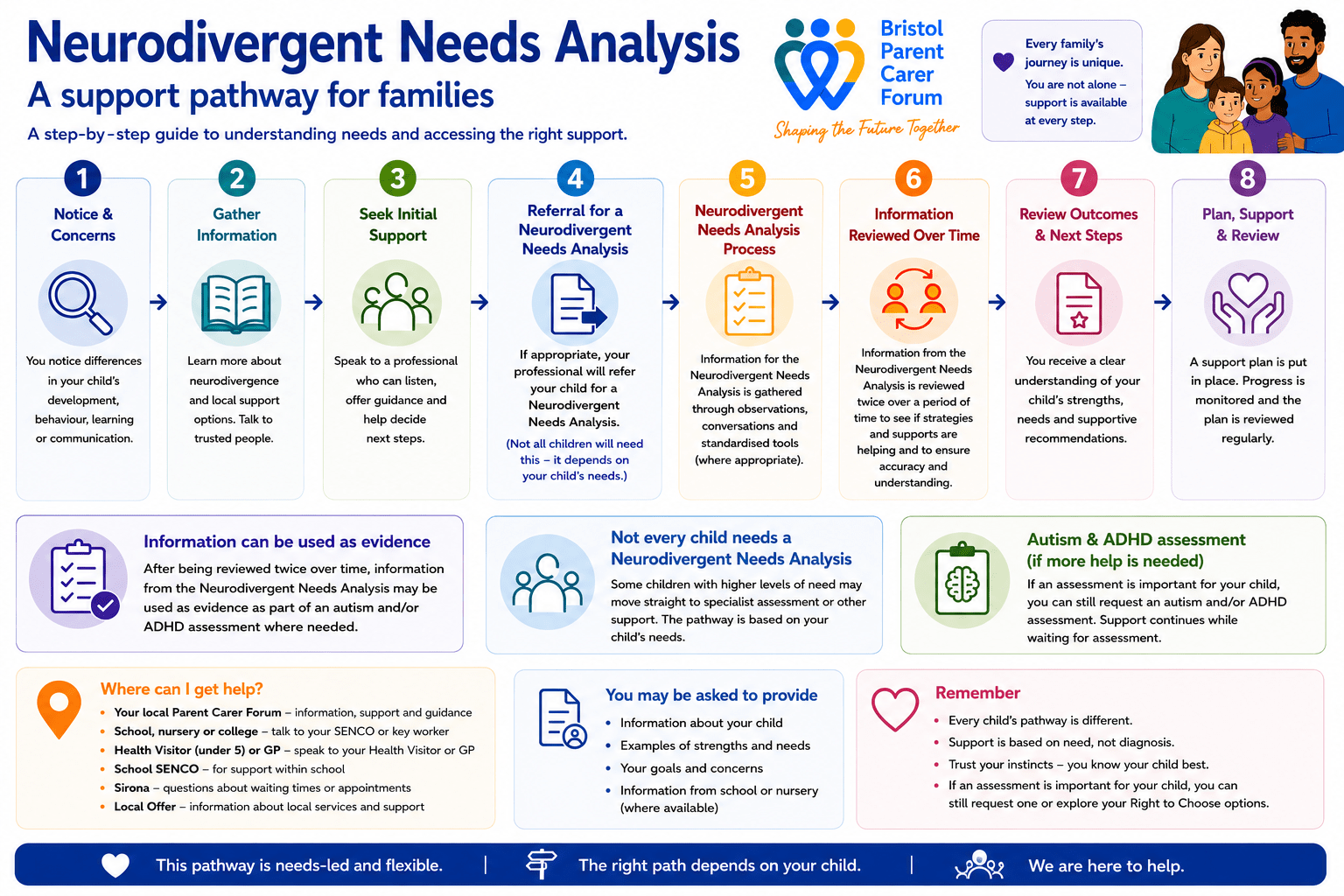
Neurodivergent Needs Analysis
At a glance
This page explains the Neurodivergent Needs Analysis pathway.
The pathway is for children and young people who may have neurodivergent needs. It helps families and professionals understand a child’s strengths, needs and the support that may help.
It is needs-led and flexible. This means the right path depends on your child. Not every child will need a Neurodivergent Needs Analysis.
What is a Neurodivergent Needs Analysis?
A Neurodivergent Needs Analysis helps build a clearer picture of your child’s needs.
Information may be gathered through:
- conversations with you and your child
- observations
- information from school, nursery or college
- standardised tools, where appropriate
The aim is to understand what support may help your child, rather than waiting for a diagnosis before support is considered.
The pathway
1. Notice and concerns
You may notice differences in your child’s development, behaviour, learning or communication.
2. Gather information
You can learn more about neurodivergence and local support options. It can help to speak to trusted people who know your child.
3. Seek initial support
Speak to a professional who can listen, offer guidance and help you think about next steps. This may be someone in school, nursery, college, health or another support service.
4. Referral for a Neurodivergent Needs Analysis
If appropriate, a professional may refer your child for a Neurodivergent Needs Analysis.
Not all children will need this. Some children may need a different type of support or may move straight to specialist assessment.
5. Information is gathered
Information is gathered about your child’s strengths, needs and daily life. This may include conversations, observations and tools.
6. Information is reviewed over time
The information is usually reviewed twice over a period of time. This helps professionals understand whether strategies and support are helping.
7. Review outcomes and next steps
You should receive a clearer understanding of your child’s strengths, needs and support recommendations.
8. Plan, support and review
A support plan is put in place. Progress should be monitored and the plan reviewed regularly.
Can this be used as evidence for an assessment?
Yes. After being reviewed over time, information from the Neurodivergent Needs Analysis may be used as evidence as part of an autism and/or ADHD assessment, where needed.
Does every child need a Neurodivergent Needs Analysis?
No. Not every child will need this pathway.
Some children with higher levels of need may move straight to specialist assessment or other support. The pathway should be based on your child’s needs.
Autism and ADHD assessment
If an assessment is important for your child, you can still request an autism and/or ADHD assessment.
You may also be able to explore Right to Choose options.
Support should continue while your child is waiting for assessment.
What might I be asked to provide?
You may be asked to share:
- information about your child
- examples of their strengths and needs
- your goals and concerns
- information from school, nursery or college, where available
Where can I get help?
You can speak to:
- your local Parent Carer Forum
- your child’s school, nursery or college
- your child’s SENCO
- your Health Visitor, if your child is under 5
- your GP
- Sirona, if you have questions about waiting times or appointments
- the Local Offer, for information about local services and support
Remember
Every child’s pathway is different.
Support should be based on need, not diagnosis.
Trust your instincts. You know your child best.